Niels Obers
Research
On this page you can find an overview of my past and present research
(status as of 2017)
Current Research Directions
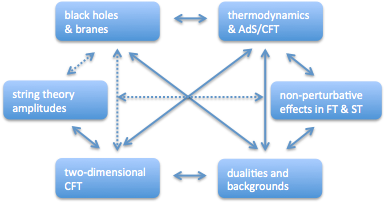
The gauge/gravity correspondence, embodying the holographic principle, has emerged as one of the most fascinating and powerful new concepts in modern theoretical physics. A crucial role in this correspondence is played by black holes and branes. On the one hand these reveal novel features of finite temperature field theories at strong coupling, with possible relevance to QCD and even condensed matter (CM) systems. On the other hand the gauge/gravity correspondence is providing new insights into the emergence of spacetime and the puzzles related to the quantum nature of black holes. My research centers around these two related prospects of holography, building mostly on my most recent work but also utilizing possible connections to earlier work (see the 2nd diagram further below, which depicts the web of connections between my research directions.) Some more specific directions that I am currently pursuing (or intend to) are:
- Non-relativistic geometry in field theory, gravity, holography and string theory
- Extensions of the blackfold method
- Thermal probe branes and the AdS/CFT correspondence
-
-String theory amplitudes in curved backgrounds
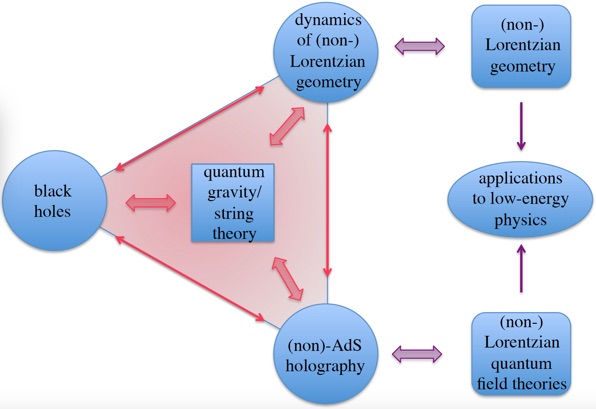
Currently my main focus is on the first of the above, which amounts to exploring the vast landscape of interesting new structures and connections underlying non-Lorentzian geometry (as summarized in the diagram below)
Research (summary of past)
My research area is centered around string theory, quantum field theory and gravity. Since this field is constantly in flux and since I have a broad interest in these topics, my more specific research themes over the last two decades have been diverse. The directions that I have addressed and made contributions to can roughly be summarized as follows:
I.Conformal field theories in two dimensions
II.Duality symmetries in string/M-theory and exact string backgrounds
III.Non-perturbative effects in field theory and string theory
IV.Thermodynamics of branes, thermal field theories and the gauge/gravity correspondence
V.Black holes in four and higher-dimensional gravity theories
VI.New structures in string theory amplitudes
Many of my articles already involve by themselves aspects of at least two of these research themes, and the diagram below indicates in more detail a web of connections among these themes. The solid arrows represent connections that are currently present and which will be further exploited, the dashed arrows represent additional new connections that could be interesting for the future,
Below follow some highlights of my past research.
I. Conformal field theories in two dimensions
As a PhD student and some years thereafter I have been working on the development of the foundations of irrational conformal field theory (ICFT). The review article [45] collects my main achievements and contributions to this program, which can be separated into two directions. The first direction focussed on obtaining new solutions by analyzing the Virasoro master equation and classifying the space of ICFT’s. The second direction has been concerned with understanding the dynamics of these conformal field theories via Ward identities and semi-classical methods.
II. Duality symmetries in string/M-theory and exact string backgrounds
A major revolution in string theory has been the insight that the various string theories are related by a web of both perturbative and non-perturbative dualities. Understanding these dualities is important towards a better insight into the structure of the underlying unifying theory, M-theory, while at the same time dualities can be used to generate new exact back- grounds from known ones. In this connection, Ref. [47] investigated classes of exact string backgrounds corresponding to four-dimensional plane gravitational waves using a new type of duality symmetry [48]. In another direction, I have been involved in the study [39] of what can be learned about M-theory and the BPS spectrum of string theories, using the U-duality symmetry that arises after toroidal compactification. Much of this work, culminated in Ref. [38] which is a comprehensive review on U-duality and M-theory. This work describes from the ground up how U-duality can be used to uncover the spectrum of BPS states in maximally supersymmetric toroidal compactifications of M-theory, as well as its applications to the study of matrix gauge theory. This work has become a standard source for any research involving U-duality symmetries.
III. Non-perturbative effects in field theory and string theory
One of the beautiful properties of non-perturbative dualities is that one can gain information on non-perturbative effects in string and field theories. Here a special role is played by D- brane solitons and instantons along with special terms in the effective action that that receive contributions from BPS states only. One can use such terms to test the duality hypotheses, but on the other hand the duality conjecture can also be employed to derive rules for the semi- classical instanton contributions. The works [32,34,37,40-42] (relying in part on II) consider various classes of such BPS-saturated terms in the effective action, and have led to many new insights in non-perturbative stringy instanton effects arising from D-branes and the NS5-brane. One of the first examples where this was applied in the literature is Ref. [42], which studied F 4 terms in heterotic/type-I duality to show that world-sheet instanton terms on the heterotic side get mapped to D1-brane instantons on the type I side and extracted the semi-classical rules for the corresponding D1-instanton calculation. In a parallel direction related to non-perturbative effects in field theory, Ref. [25] was among the first to study the Dijkgraaf-Vafa proposal in supersymmetric gauge theories with SO(N ) gauge groups.
IV. Thermodynamics of branes, thermal field theories and the gauge/gravity correspondence
A key development in string theory has been the gauge/gravity (or AdS/CFT) correspondence. In particular, this relates the near-horizon limit of various brane solutions of string and M-theory to the strongly coupled (large N ) limit of a dual quantum field theory. From the thermodynamics of the corresponding black brane solutions, one is then able to obtain information on thermal field theories at strong coupling. I have been involved in examining this connection from a variety of viewpoints: considering spinning p-branes relevant for gauge theories with non-zero chemical potential [36], brane bound states corresponding to non-commutative gauge theories [35], NS5-branes revealing the physics of Hagedorn behavior of little string theory [17,33], pp-wave backgrounds in compactified spaces yielding a novel scaling limit of N = 4 SYM [27] and new phases of near-extremal branes on a circle [15,18,20] leading to predictions of new phases in their dual field theories. This body of work thus examines from different perspectives many of the deep features of the gauge/gravity correspondence at finite temperature, and has revealed a multitude of novel phenomena.
Moreover, it naturally led to the research theme V described below, and in fact, following the recently developed blackfold approach to higher-dimensional black holes, I have recently returned to this topic. In particular, Refs. [1,3] propose a new method to consider D-brane probes in thermal backgrounds. The new method was applied to find the thermal generalization of the BIon solution of the DBI action, exhibiting unsuspected effects. More generally it opens up for a wide array of applications in the gauge/gravity correspondence and possibly deep insights into the physics of black holes, as will be further commented on below.
V. Black holes in four and higher-dimensional gravity theories
Four-dimensional black holes in Einstein gravity are known to possess a number of remarkable features such as uniqueness, spherical horizon topology and dynamical stability. Recent research has revealed, however, that the phase structure of higher-dimensional black hole spacetimes is far more complex and vast than what was a priori thought. This has led to numerous new developments in the field of higher-dimensional gravity including applications in string theory and gauge theory.
This line of research started with Refs. [24,28] (and subsequently [12,21-23]) which are the first to systematically analyze the phase structure of black holes in spaces with a compact direction, much of which is reviewed in the Editor’s choice review [14], which is mainly based on own re- search. This study originated in fact from my interest into phases of near-extremal branes on a circle (see IV), since these can be generated from neutral solutions by U-duality transformations (see II). I have subsequently turned my attention to higher-dimensional black holes in asymptotically flat spaces, since the methodology and phase diagrams obtained in the former have a direct impact on the latter case. This resulted in Ref. [11] in which an approximate solution for an asymptotically flat, neutral, thin rotating black ring in any dimension greater than four was obtained, and predictions for a more complete phase diagram were made. This paper is thus the first to present compelling evidence for the existence of higher-dimensional black objects with novel horizon topology, beyond the exactly known five-dimensional black ring. Building on the results of [11] we then proposed in [7] (published in PRL) a new, approximate analytic method for constructing stationary black hole solutions in higher dimensions. This method, called the blackfold approach, constitutes a breakthrough in our understanding of the phase structure and dynamics of higher-dimensional black holes. The approach is based on an effective theory that describes how to bend the worldvolume of a black brane in a given background spacetime and can be formulated in terms of an effective fluid that lives on a dynamical worldvolume. The blackfold method was further developed in [6] and applied in [5,2]. The generalization to blackfolds in supergravity and string theory, which obviously has intimiate connections to topic IV, will soon appear [75].
VI. New structures in string theory amplitudes
Recent years have seen many new techniques and insights for the calculation of scattering amplitudes within field theory inspired by Witten’s twistor string proposal. Since field theory arises as the low energy limit of ordinary string theory in a flat background, a natural question is to what extent these advances for fields can be carried over to strings in this setting. I have been among the first addressing this question in Refs. [4,8], in which we showed that Britto- Cachazo-Feng-Witten (BCFW) on-shell recursion relations also hold in the context of string theory. Besides a more direct route, we also employed an argument based on two-dimensional conformal field theory (see I). These studies mark the beginning of a research direction that has much potential for further exploration.